FROM THE HISTORY OF ROSES INORNAMENTAL GARDENING
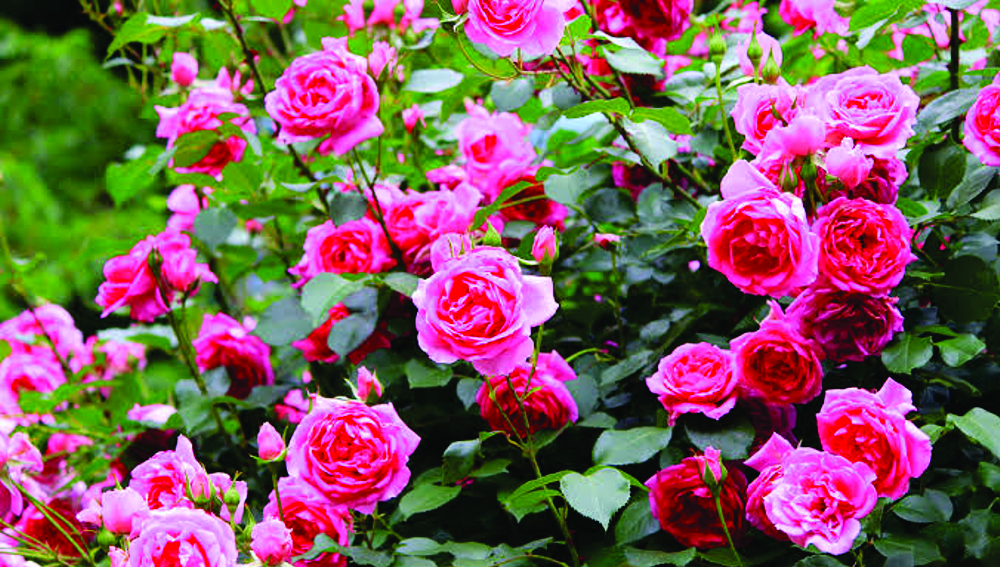
17 Since ancient times, the rose has beendecorating nature with its fragrance andtints of colours, invariably attracting thepeople’s eyes. Over the centuries, man,through hard work and talent, has createdamazingly beautiful forms and varieties ofthis flower. The rose is rightfully consideredone of the most beautiful ornamental plants.Its stylized images are often found in theornaments of the oriental carpets and inelements of decorative calligraphy.
Since the origins of the culturalcultivation of roses go back to ancienttimes, researchers note the difficultyof accurately determining the periodof its appearance in the era of ancientcivilizations. The cultivation of roses is puton a par with such fruit crops as grapes,apples, apricots and olives‒ we knowthe deep respect and love with which thisplant was surrounded in ancient Babylon,the capital of the Persian Empire. It is nocoincidence that the tradition of drinkingrose water arose in Iran, thanks to whichthis country received the name Gulistan("Country of Roses").
From Iran and Asia Minor, rosesspread widely to Ancient Greece, andfrom there they penetrated into Egyptand Rome. In the middle of the 1stcentury BC, specially grown gardenroses were supplied from Egypt to theRoman Empire in huge quantities.
The scientist Herodotus in his workstells that in Macedonia, in the gardens of King Midas, roses grew with sixty petals.Another ancient scientist, Theophrastus,three centuries before BC, in his book,left detailed descriptions of the origin ofthe rose and methods of its cultivation,making a clear distinction between wildand cultivated species. In that era, such species as Damask rose (R. DamascenaMill.), Centifolia rose (R. centifolia L.)and Moss rose (R. muscosa Ait.) became widespread in gardening. Since the 12th century in Europe, theinterest in wild roses has increased –wild roses, such species as the dog rose (R. Canina L.), field rose (R. Arvensis Huds.),red-brown rose (R. rubiginosaL.) and Alpinerose (R. Alpina L.). Thereason for this was their ability to easily interspeciescrossing, which under natural conditionsled to the formation of numeroushybrids. In the gardening culture of Russia inthe 12th–13th centuries, the dog rose waswidely bred both for decorative purposesand for medicinal needs. As a result of crossing natural hybridsof wild roses with cultivated species, manydifferent varieties were obtained, including:
Centifolia rose (R. centifolia L.),Mosscentifolia (R. centifolia L.f.muscosaSchneid.), Pompon centifolia (R.centifoliaL.f. pomponia Lindl.), Damask rose(R. damascena Mill.), white rose (R. alba L.),Portland rose (R. portlandica hort.) and others. At the end of the 18th ‒ beginning ofthe 19th centuries, after light pink teaand Bengal roses were imported to theEuropean countries from India, a new erain breeding began. This gave impetus tothe creation of valuable modern varietiesbased on hybridization with existingspecies. Ancient Roman writer and scientistPliny the Elder, in his fundamental work"Natural History", consisting of 37books, mentions 12 species of cultivatedroses and 12 species of other ornamentalplants. He wrote:"The rose is a queen offlowers, the most beautiful decoration offields and gardens". According to the historical data,the primary centres of origin of rosesare considered to be West Asia (AsiaMinor, Transcaucasia and Iran) and EastAsia (China, India). The main ways of spreading cultivated roses developed inthree key directions:
1) Widespread distribution of groupsof Gallic roses (R. gallica), which began
even before our era from Asia Minorthrough the islands of the Aegean Seaand Macedonia to Greece. From therethey were introduced to Rome, then,appeared in Egypt, and later in Spain andFrance;
2) Distribution and adaptation ofgroups of the Chinese roses ‒ Chinese
rose (R. Chinensis), Vihurayan rose (R.wichuraiana), which in ancient timescame from China to India, and at thebeginning of the 19th century werebrought from India to the Europeancountries (France, England);
3) The third stage of expansion ofthe range of roses was associated withthe spread of varieties created by the European gardeners (mainly, in France).In the middle of the 19th century, thesebreeding achievements began to beactively exported from Europe to othercountries of the world.
Cultivation of roses in the countriesof Central Asia also dates back toancient times; It is no coincidence thatthis flower has earned the poetic name"flower of legends". In the 9th–10thcenturies, strong trade ties wereestablished in Bukhara, the capital ofthe Samanid state, with the Middle East,Russia and China. The items of exchangewere perfumes made from roses, variousoils, incense, as well as the seeds of thisplant. In modern taxonomy, the genus Rose(Rosa L.) is a large botanical group. For the most part, these are upright shrubs of1–2 meters high, but other forms are alsofound. Among roses, there are deciduous,semi-evergreen and evergreen species.Their shoots can be either covered withthorns or completely smooth (thornless).For example, theInermis Morlettiivariety, which belongs to the garden group of alpine roses (R. alpina), isdistinguished by the complete absenceof thorns on the shoots. In the book"Plant"by the scientist F. Kohn,a tree-like specimen of wild rose (R. canina) ismentioned, growing in front of HildesheimCathedral. Its heightreaches 13 meters,the trunk diameter is 50 centimeters, andits age is about 300 years. Historical data indicates that in ancienttimes, the residential farmsteads nearMerv and Urgench were filled with thefragrance of roses. For many years, the research workersof the State Central Botanical Gardenof the Ministry of Agriculture of Turkmenistan have been conductinglarge-scale research work on theacclimatization of plants, includingvarious species of roses, the seeds ofwhich are imported from differentcountries of the world. Studying theiradaptability to our soil and climaticconditions, the scientists select the bestspecimens and recommend them for usein landscape design, landscaping theparks and gardens in our country. Flowers are an integral part of our life,they are the decoration of our happy daysand celebrations, a symbol of peace, joyand beauty.
Shykhmyrat Baymyradov,
State Central Botanical Garden of theMinistry of Agriculture ofTurkmenistan,Candidate of AgriculturalSciences
Dovletmyrat Amandurdyyev,
State Central Botanical Garden of theMinistry of Agriculture ofTurkmenistan